Film editing is the use different techniques to put footage together in order to make effects or to cut between different scenes. The first ever edit was discovered by accident in 1896, when George Melies' camera jammed whilst filming a bus in Paris. After Melies got the camera working again, the bus had gone past and in its place, a herce was now parked. When looking through the film reel, George realised it looked like the bus had transformed into the herce in an instant. This was the birth of the first edit. Eventually, people took it on themselves to create new cuts and transitions, such as fades or dissolves, which allowed directors to show time passing and other such details. As well as this, directors began experimenting with camera angles. Whilst watching their new films, some directors saw that their scenes were hard to follow due to editing clashing with their camera angles. After a while, rules for editing and filming were formed and eventually turned into the continuity system we have today. These rules include the 180 degree, establishing shots and match on action shots.
Django Unchained
In this scene in Django Unchained, directed by Quentin Tarantino, there is a vast array of camera angles, shots and continuity.


In the rules of continuity lies the 180 degree rule. This rules suggests that the camera should never cross over from left to right between shots to enable the audience to easily follow the action and who is carrying out the action. In this part of 'Django Unchained', there are various uses of this rule. Such an example would be when Calvin Candie and Dr. King Schultz are talking. The camera always stays on the left hand side of Christopher Waltz, but the reverse shot of this is when the camera swaps to Leonardo DiCaprio's right hand side. A reverse shot is when the camera shows the opposite direction to the last shot; such as when these two characters are talking. These two rules combined, allow the audience to stay engaged in the film without having to stop to think about what is going on when the action becomes unclear and messy.


In this scene, there are also match on action shots which show an action in two or more shots. These kind of shots have to be fluent and well executed in order to make sense and appear interesting. The example in this scene is when Dr. King Schultz gets shot and gets sent flying back by the blast. From when the pellets from the shotgun hit him to the next shot when his feet lift off the floor, is a match on action shot. These few shots allow the audience to keep track of whats going on as they show the correct steps of the action very clearly. Although these two shots happen very quickly, it empahsises the speed and shock factor of the action, which keeps the viewers intrigued and aware.


As well as this, they also include motivated editing which is when a certain shot influences the next shot. Such a sequence happens in this scene, when Dr. King Shultz whips out a gun pulls the trigger on Calvin Candie in one shot, then the bullet hits him in the next. These shots allow a sequence to move forward and make sense, by linking the action together. This lets people follow the scenes a lot more fluently without missing key parts of action.
Audience Identification
 Throughout this scene, many types of camera shots that allow the audience to connect with characters and see their emotions, thoughts and their intents, are used. A good example of this is when Quentin Tarantino uses close ups during an intense scene to build tension and create a hostile atmosphere. In the shot on the right, Leonardo DiCaprio's character has just been shot and this close up shows the audience his face of shock as he clearly didn't expect the turn of events that lead to him being shot.
 Screen time also links in with close ups, as screen time all depends on how long a character is shown on screen throughout a scene or entire film. Usually, main characters are shown a lot more frequently to emphasis their importance. Despite this, in the film 'Kiss me, deadly', the main character is not shown until the second half of the film, until which point, only his shoes are shown. This type of behavior in a film is used to create tension and build up to the moment where the character is revealed. In 'Django Unchained', Jamie Foxx had the most screen time, as he is the main character. This constant screen time allows us to see that he is the main protagonist in the film, alongside other people, such as Leonardo DiCaprio and Christopher Waltz's characters, and build a bond with them, more than less relevant characters.
 |
| This shot shows Django (Jamie Foxx) in the background of a scene. Although he is not in the foreground or in the center of the scene, it still shows he's involved in the scene, no matter how small the part. |
 |
| This shot is a close up of Django, which implies he's more involved in what is currently happening, or that the director wants us to see his emotions at this point |
 |
| This wide shot shows Django and another character in the center of the frame. This implies that he is a main part of the action as well as the other character. |
 |
| This shot allows us to see several people at once, although Django is the only one doing any action. This draws our attention to him a lot more than anyone else is on screen, apart from when the fall to the floor. |
Reservoir Dogs
 Throughout this video, many of Quentin Tarantino's films include POV scenes. Many of these shots are from the trunk of a car. The first clip of this video comes from 'Reservoir Dogs', and shows the point of view of a cop from the trunk of their car. These kinds of shots allow us as the audience to see from their eyes, therefore making us feel their emotions. In this scene, it makes us feel intimated and weaker than the three characters standing above us.
This immerses us in the story by putting
us in the world we're watching and feeding us emotions.
Avengers Assemble
In the film 'Avengers Assemble', there are countless shots used. The scene in which Bruce Banner shows up on a motorcycle, shows this very well as it compacts multiple shots into a short amount of time. This allows the directors to show many different or the same thing, but in various ways.
 |
| This is a close up f Tony Stark. This shot allows us to see his emotion at this point in time, as well as to see small details in his suit. |
 |
| This is a high angle shot. This is used to show how small and weak the civilians and vehicles are compared to the force of the invasion above. This also gives us a subliminal sense of scale and power of the aliens, as well as how devastated the city already is. |
 |
| This is a wide shot which allows us to see the entire group of heroes, as well as the background of the city. This kind of framing shows us them coming together and getting ready to fight which adds to the impact of the following shots. |
 |
| This shot follows the previous example and is actually a tracking sot in the actual clip. This continuous shot allows us to see that these heroes are finally coming together as one mighty team, by showing them all in one, not many cut up shots. |
Zombieland
 Montages allow any amount of time to be shown is a short period, to show important things or just to skip time to shorten a film, or to give affect. The opening credits scene to 'Zombieland' is a montage of various zombies chasing and attacking people in different scenarios. This kind of opening is great for this type of movie as it shows the zombie outbreak over the first few weeks or months after it starts, leading into the story which is set a while into the apocalypse.
 Psycho
 In film, directors use various mediums to withhold certain information from the audience to create atmosphere. In the famous shower scene from 'Psycho', the shower curtain stops us from seeing the true identity of the killer walking up to the shower. This builds tension and adds more reason for the audience to keep watching in order to find out who the killer really is. These restriction techniques can also be used to keep a film to its age rating, as horror films or any kind of unsettling scenes can be cut away from before
they begin to get gory or unsuitable.
Breaking Bad
 Directors also provide the audience with information, whether it be direct through dialogue, or through imagery. In episode one of season one of Breaking Bad, Walter White finds out he has lung cancer. This information is provided partially through imagery, but finally revealed through dialogue. The scene shows Walter in an MRI machine, followed by him sitting in a doctors office speaking to the doctor. The sound is muted and we see that Walter isn't concentrating on the doctor's words which tells us what he's saying is shocking. This gives us the impression that he may have some sort of disease or life changing news, such as cancer.
Silence of the Lambs

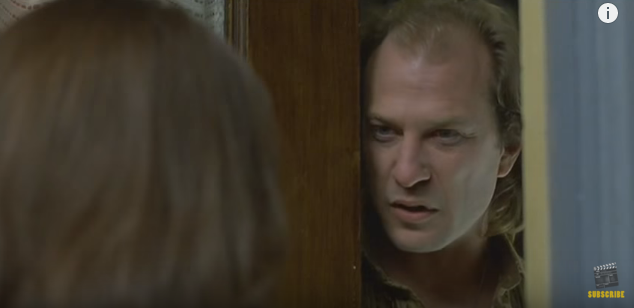
Parallel editing is used to show events happening at the same time, but in different locations. This is used well in a scene during 'Silence of the Lambs' in which the police raid a house they think the killer is hiding in, while we are shown the killer at the same time, in a different location. This works well because it builds tension as we think they're closing in on him, but in actual fact he's miles away. They use the door bell ringing at both houses to make it seem like the house
they are raiding is the house the killer is in. The illusion is proven wrong when the killer answers the door to someone else at a different house.
 Transporter 3
Editing rhythm is the skill of editing a scene to match the contents of said scene. This is shown prominently in many action films such as the 'Transporter' franchise. In 'Transporter 3', there is a fight sequence that takes place at the beginning of the movie. Its pacing and rhythm of the shots in this scene are fast and sleek which parallels the action and flows well as a result. The music in this scene also has an impact on the overall outcome, as rhythm of a scene can often be molded by the music used. The music in this particular section is fast and bouncy, which mirrors the rest of the contents.
The Walking Dead

 The construction of time and space inside of film and other media is conveyed through many different methods. An example of these would be in the ending of episode ten of seasons six of The Walking Dead, in which Michonne and Rick are seen kissing and getting more intimate on the sofa in one room, then it fades into the next scene in which they are both naked in bed in another room together. This is a good depiction of time as it doesn't show all the unimportant details such as undressing; it shows the obvious outcome to the actions we saw prior. They leave out these small details to save the audience getting bored, as we as an audience are smart enough to put together two shots if they are constructed well enough to portray a sequence of actions.
As well as this, an example of space being portrayed in this scene is when both characters jump up and a match on action shows them grabbing their weapons and aiming them at an intruder. The concept of characters moving and completing actions within a shot or scene is the construction of space. It allows us to see they are in an actual universe of their own, and with other details, makes it seem real and thriving.

The Fast and the Furious

 Cutting to soundtrack is when the cuts and pace of the scene are motivated by the speed of a song. This is prominent in the Fast and Furious franchise during any of their chase scenes, like in one of the more memorable ones from the first installment where Brian O'Conner and Dominic Toretto chase down a drive-by gunner. This works well in these types of films as it uses fast paced and intense music to make hard hitting moments feel more powerful. These mix between engines, gunshots and tense music really allows the audience to submerge themselves in the action and feel on the edge of their seat all the way through each scene. These two images show good examples of cutting to soundtrack within this scene, as it includes drops and bass whenever the motor bikes land heavily or when sharp turns are made.
Iron Man

 Shooting a film from multiple points of view is when the camera shows the scene from many different places and shows the different people in said scene. It can portray characters in a new light and show different aspects of a scene that wouldn't otherwise be shown. This happens in many films but one of example would be in one of the final scenes within 'Iron Man' where the final showdown between the protagonist and antagonist happens. In this scene, the destruction and actions are shown from many angles that show different characters as the main icon of the shot. This technique allows the audience to see the scene in entirely different ways in every shot and lets them build a connection with each character as they are shown. It also keeps the attention of the audience as its fast paced and changes the aesthetics of each shot which is more interesting to viewers.
The Walking Dead
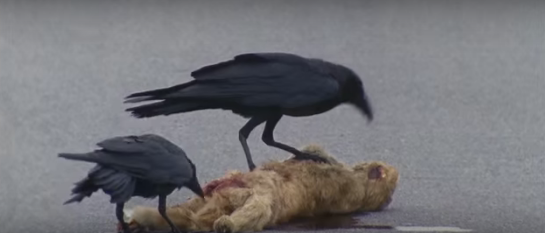 Cutaways are used as ways to subtly hint things to the audience or to indicate the tone of a scene, such as when rain on a window is shown that could indicate the scene is going to be depressing or dark. An example of this would be in the first episode of 'The Walking Dead' when the camera cuts to a crow in the middle of the road pecking at a dead animal before a car chase and shootout takes place. This works well because it hints the future of the world and how its going to fall into chaos and sets up the brutal tone for the coming scene. These kinds of shots allow the audience to interpret things in their own way, although some people don't even pick up on the subtlety because they can often be very abstract.
Mad Max: Fury Road
 Jump cuts are used in pretty much every film, although some are more prominent than others. Jump cuts are when a scene is cut up quickly to make it more fast paced and frantic. In action films, fight sequences are full of jump cuts to give a fast paced and disorienting feeling to them in order to immerse the audience in the scene. An example of this would be in a fight sequence in 'Mad Max: Fury Road' between Furiosa and Max. The fast paced editing of this scene gives the audience a sense of speed and accuracy with every cut. This cutting technique often works with cutting to soundtrack to add impact to every shot switch and immerse the audience further.